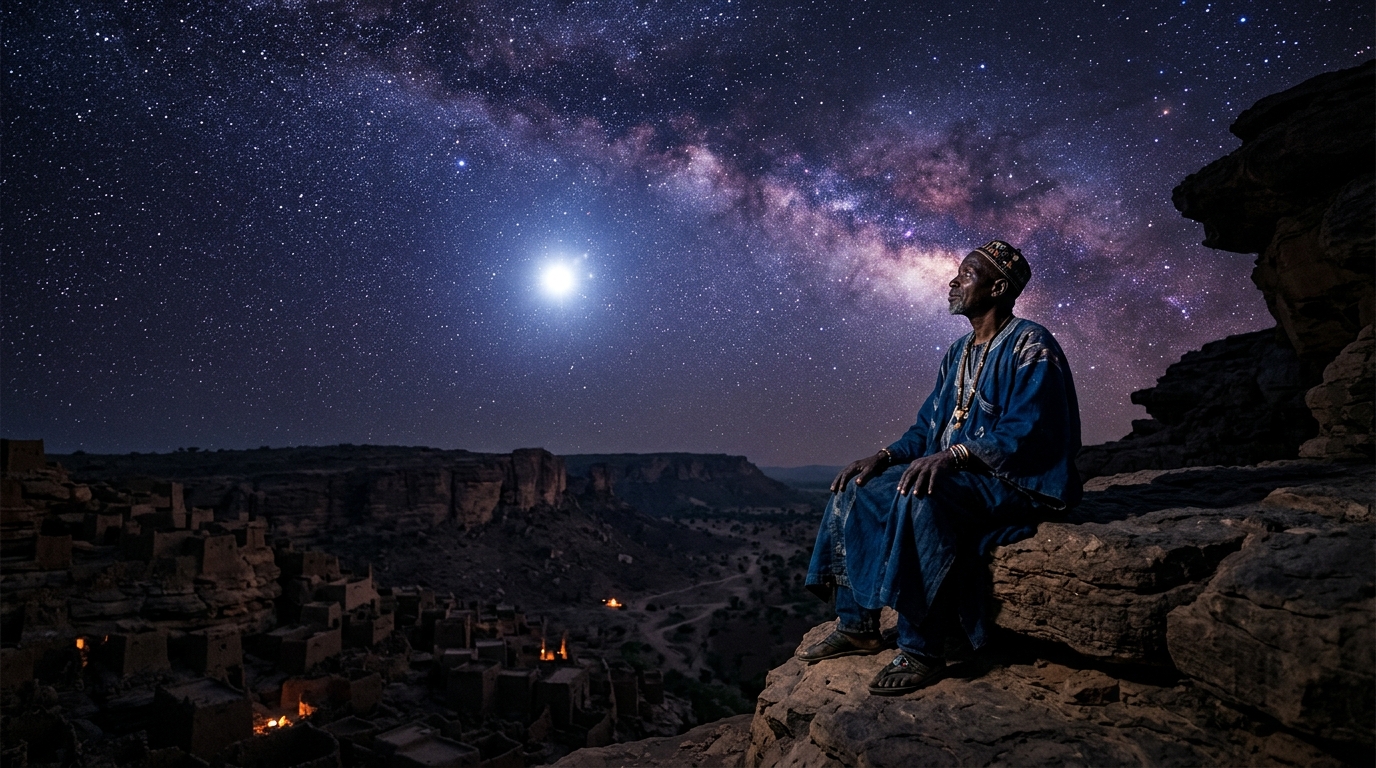
In the Bandiagara Escarpment of Mali, the Dogon people have lived for centuries in villages carved into the cliff face. Their culture is rich and layered, with a cosmology, a calendar system, and a body of astronomical knowledge that took Western researchers decades to begin to properly understand.
When French anthropologists Marcel Griaule and Germaine Dieterlen spent time with the Dogon between 1931 and 1956, they documented something that did not fit into the accepted narrative of which peoples possessed advanced scientific knowledge and which did not. The Dogon described a star orbiting Sirius, the brightest star in the night sky. They called it po tolo. They said it was incredibly dense and heavy. They said it moved in an elliptical orbit around Sirius and that the orbit took about 50 years to complete.
That star is Sirius B, a white dwarf companion to Sirius A. It is so faint and so close to the brilliance of Sirius A that it cannot be seen without a powerful telescope. Western astronomers first observed it in 1862. The Dogon had incorporated it into their cosmological tradition long before any recorded contact with modern astronomy.
What the Dogon Actually Said
The Dogon do not describe Sirius B as a discovery or a recent addition to their knowledge. It is woven into the oldest layers of their religious and ceremonial tradition. The Sigui ceremony, held every 60 years to mark the movement of Sirius relative to the sun, is one of the most significant events in Dogon cultural life. Preparation for the ceremony begins seven years before it takes place.
Their knowledge of po tolo included several specific details that were later confirmed by modern science. They knew it was small. They knew it was made of a material they described as the heaviest thing that exists. White dwarfs are among the densest objects in the observable universe, a teaspoon of white dwarf matter would weigh several tonnes on Earth. They knew its orbit was roughly 50 years. The actual orbital period of Sirius B around Sirius A is approximately 50.1 years.
They also described a third star in the Sirius system, which they called emme ya tolo. As of now, a third star in the Sirius system has not been confirmed by modern astronomy, though some researchers have proposed it might exist. This detail remains unresolved.
The Explanations on Offer
Since Griaule and Dieterlen's research was published, a number of explanations have been proposed. The most common sceptical argument is that the Dogon must have acquired this knowledge from contact with a Western traveller or missionary before the anthropologists arrived. This is possible in principle. But no specific source has ever been identified, and the Dogon's description of po tolo as a religious and cosmological concept, not a piece of borrowed scientific data, makes casual contamination a difficult explanation to sustain.
Astronomer Carl Sagan suggested that Griaule may have inadvertently introduced the concepts himself during his questioning, and that the Dogon then incorporated his descriptions into their explanations. This is also possible, though critics of this view note that Griaule was a skilled ethnographer who was aware of leading-question bias, and that some of the descriptions pre-date his visits in written accounts from Dogon oral tradition.
Another explanation, one that many researchers find quietly compelling even if they are reluctant to say so publicly, is that the Dogon had highly sophisticated observational astronomy passed down across generations. Some researchers have proposed that under ideal conditions, with very dark skies and a specific visual technique, Sirius B may be observable to the naked eye during certain periods. No one has demonstrated this conclusively, but it has not been ruled out either.
A Knowledge System Worth Taking Seriously
Whatever explanation you find most persuasive, the Dogon case forces a confrontation with a habit of thought that has distorted how we approach ancient knowledge systems from Africa and other parts of the world that were colonised and dismissed.
The assumption that pre-modern African cultures could not have developed sophisticated astronomical knowledge is not based on evidence. It is based on a story that was told to justify certain arrangements of power, and it has taken enormous effort from archaeologists, historians, and anthropologists to begin dismantling it.
The Dogon had a calendar. They had a cosmology. They had ceremonial cycles tied to the movement of specific stars. Whether or not po tolo represents independent discovery, transmitted knowledge, or something else entirely, their astronomical tradition is real, it is documented, and it deserves to be treated with the same intellectual seriousness we extend to ancient Greek or Babylonian astronomy without a second thought.