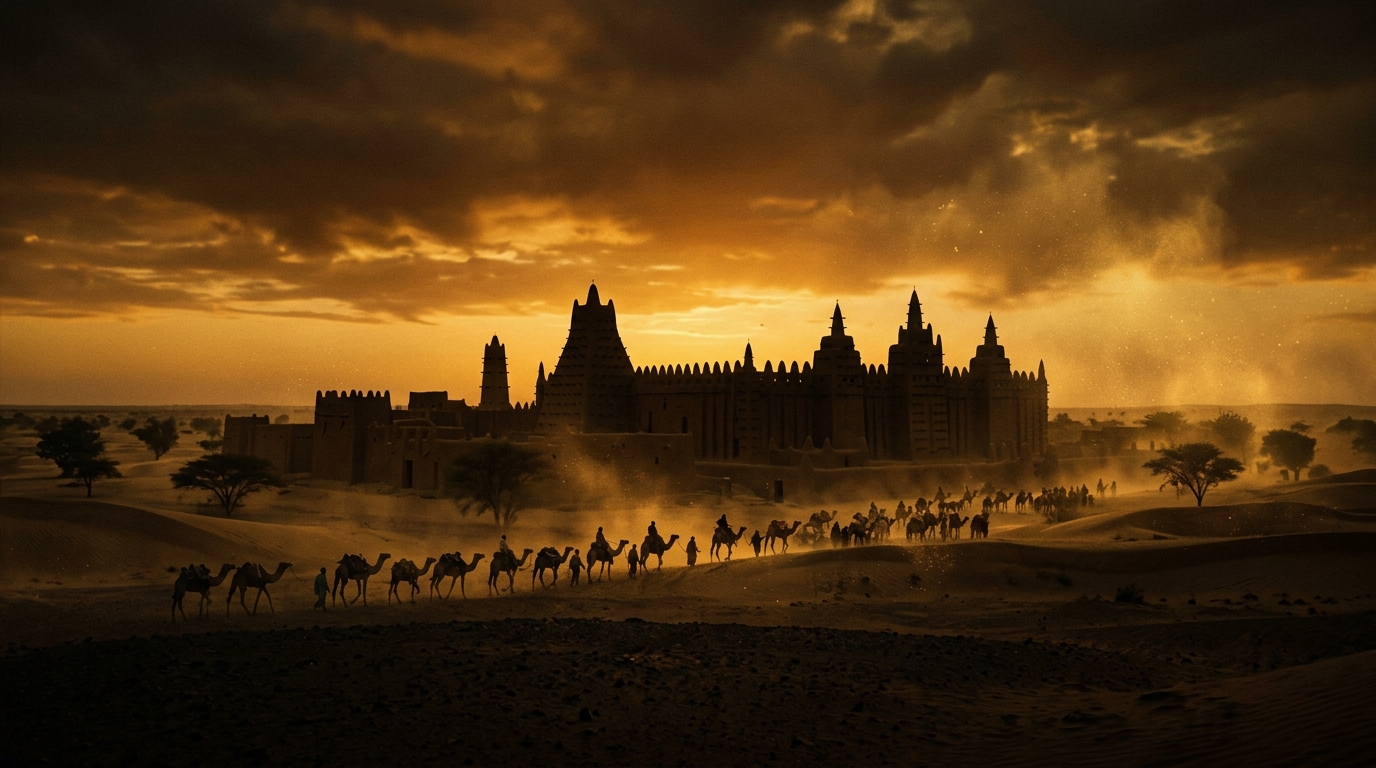
There is a name that almost never appears in Western history books, yet historians who study wealth, power, and ancient economies will tell you he stands in a category entirely his own. His name was Mansa Musa, and he ruled the Mali Empire in West Africa during the early 14th century.
To call him wealthy is to use a word that barely scratches the surface. Economists who have tried to put a modern figure on his fortune estimate it somewhere between 400 and 415 billion US dollars, though many argue even that number does not capture the true scale. His empire sat on the largest gold and salt deposits in the known world, and for a generation, more than half of all the gold circulating in Europe and the Middle East came from his lands.
The Pilgrimage That Broke an Economy
In 1324, Mansa Musa set out for Mecca to complete the Hajj, a religious obligation for devout Muslims. But this was no quiet spiritual journey. He travelled with an entourage of roughly 60,000 people, including soldiers, heralds, servants, and attendants. Leading the procession were 500 enslaved men, each carrying a golden staff weighing about six pounds. Behind them came 80 to 100 camels, each loaded with between 300 and 400 pounds of gold dust.
The caravan passed through Cairo, and Mansa Musa spent his gold so freely, so generously, that he flooded the regional market with the precious metal. Gold, which had held a stable value for centuries, suddenly lost around 25 percent of its purchasing power across Egypt, the Arabian Peninsula, and parts of the Mediterranean. The inflation he caused took more than a decade to stabilise. A single trip to worship destabilised the economies of multiple continents.
But here is the part that most popular accounts leave out: Mansa Musa recognised the damage he had caused. On his return journey through Cairo, he borrowed gold back from local merchants at high interest, specifically to remove some of the excess supply from circulation and help restore value to the market. He understood macroeconomics in 1324.
Timbuktu and the Libraries They Never Told You About
Mansa Musa used his wealth to build something that outlasted his empire. He commissioned the construction of the famous Djinguereber Mosque in Timbuktu and invited scholars, poets, and architects from across the Islamic world to settle in his empire. Under his reign, Timbuktu became one of the most important centres of learning on earth.
At its height, the city was home to somewhere between 25,000 and 100,000 students. The libraries there held hundreds of thousands of manuscripts on subjects ranging from astronomy, mathematics, and medicine to theology, history, and law. Many of those manuscripts still exist today in Timbuktu, preserved by families who hid them from invaders over the centuries.
This is the part of the story that tends to get buried. Not the gold. Not the camels. But the fact that 14th-century West Africa was producing legal scholars, astronomers, and medical theorists at a time when much of Europe was still struggling through the aftermath of the Black Death.
Why You Did Not Learn This in School
Mansa Musa does not fit a particular historical narrative. His story requires acknowledging that one of the most sophisticated and wealthy civilisations in human history existed in sub-Saharan Africa, centuries before European colonisation began reshaping the continent and its story in the European imagination.
The Mali Empire was not a footnote. It was not a curiosity. It was a superpower, and Mansa Musa was its greatest ruler. The scholars he brought to Timbuktu, the mosques he built, and the trade routes his empire controlled shaped the medieval world in ways that are still being uncovered by historians today.
His name deserves to sit alongside the names we were taught. And the civilisation he led deserves to be understood on its own terms, not as a gap in someone else's story, but as a story complete and extraordinary in itself.